|
You are not Logged in! Log in to check your messages. |

|
|
Check todays hot topics |
Web2Project Sign in
Harbour protection: an introduction

Context
The collapse of the Eastern block in 1990 brought substantial changes in the geopolitical
strategy of land protection. From one day to the other, the funding of the USSR army was
drastically reduced and the large number of USSR navy assets start rusting in Baltic ports.
In order to be able to maintain operational a minimum number of ships and pay key personnel,
Russia and a few other former eastern block countries (like Ukraine) flooded the market with
a high number of older equipment at ridiculously low prices. It became therefore possible for
almost any country to access highly technological weapons, among which small attack submarines.
Diesel submarines in working conditions were suddenly made available to unexpected countries
such as Iran, Iraq, Syria, Egypt, Libya, North Korea, Pakistan and many others. This fact shifted
the war from the generic Atlantic typical scenario to coastal waters. This fact triggered the
so called shift from blue to brown water scenarios. More recently, after the 9/11, followed by
the March 2003 Madrid terrorist attacks, harbours and other coastal strategic facilities became
areas under close inspection as potential candidates for next terrorist targets.
Acoustic Barriers
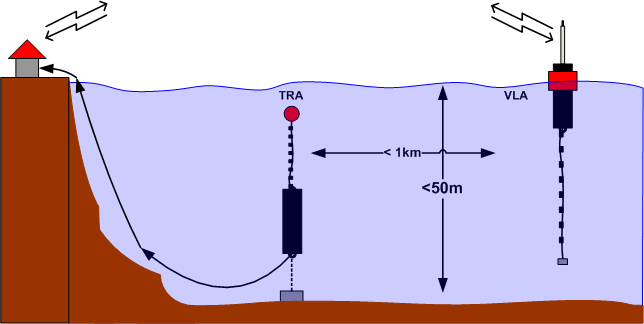
Harbour protection is a goal and not a technique. In fact harbour protection to be effective requires a number of concurrent approaches that may encompass mechanical protection (underwater steel nets), remote imaging, underwater unmanned vehicles, active high frequency sonar and acoustic barriers. An acoustic barrier is a concept that attempts to create a safe area behind a curtain of acoustic signals being able to detect any intruder. There are a number of possible ways to create that acoustic curtain. One is by placing bottom mounted transmitters / receivers so as to create a number of vertical acoustic cones to form the acoustic curtain. Another way to create an acoustic barrier is to horizontally transmit acoustic signals so as detect incoming intruders. This concept is depicted in the figure aside where an active transducer array is emitting and a passive array in the other barrier side is receiving. One of the main purposes of the two vertical arrays is to form an active acoustic standing field, which perturbation gives the indication of the intruder.
The Underwater Acoustic Barriers project
The Underwater Acoustic Barriers (UAB) project involved a number of initiatives to proof the acoustic barrier concept based on active time reversal. The purpose is to build a standing field formed by the transmission of time - reversed replicas of the initially transmitted signals for each active source - receiver pair so as to obtain cross-correlated replicas, thus maxima, at the receivers. The incoherent sum of those maxima produces a highly sensitive detector of any disturbance of the acoustic field in between transmitter and receivers. The concept is explained in this abstract and then demonstrated with real data gathered during the UAB experiment in Norway here.
Recent publications:

Noise Risk Assessment for Deep-Sea Exploration, Springer Nature,
[PDF] May 2026.
 Common dolphin's shipping noise risk assessment on the Portuguese coast,
Mar. Pol. Bull, 211 117415 [PDF]
February. 2025.
Common dolphin's shipping noise risk assessment on the Portuguese coast,
Mar. Pol. Bull, 211 117415 [PDF]
February. 2025.
Featured products:

PAM2py
download zip or github, a Python open source version of the PAMGuide package for Passive Acoustic Monitoring that features the Exchange Data Format (EDF) for facilitated underwater acoustic data sharing and metadata handling. Python allows for a crossplatform licence free processing of raw acoustic data and EDF output. A library of Python routines for EDF data reading and writing are also available. See manual here.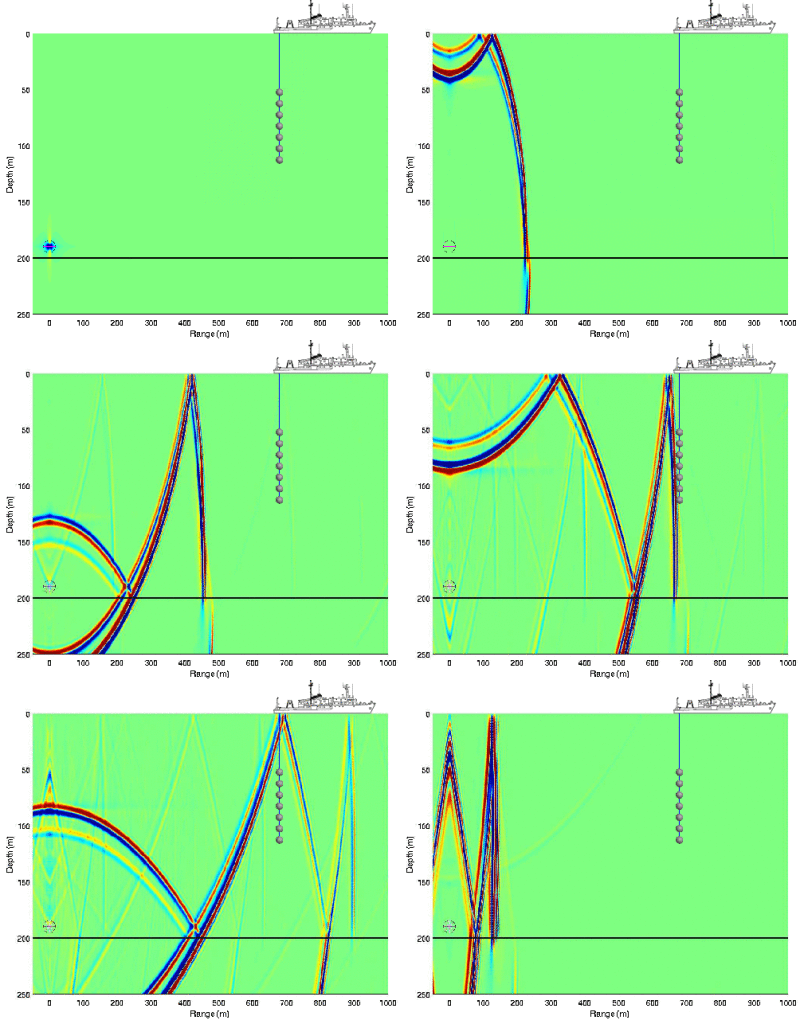
TRACEO
an efficient Gaussian beam 2D ray tracing model for underwater acoustic propagation, handling full bottom and water column range dependency, obstacle scattering and producing particle velocity outputs. See manual here and download a free copy for Fortran. A C version for linux and/or Windows is available here and for GPU here. RSS Feed
| Contact | Accessibility
| Products | Disclaimer
| CSS and
XHTML
RSS Feed
| Contact | Accessibility
| Products | Disclaimer
| CSS and
XHTML
©2009 SiPLAB, Design: OSWD